
The Anderson County Arrest Log
Start with the wider-window form of the ISOMS booking portal, linked from the sheriff's site. Some guides describe a 72-hour option. The official ACSO contact page names only Current Inmates and the 24 Hours Arrest List. The portal shows no fixed 72-hour setting. Trust the controls the page itself displays.
A multi-day window can hold Friday, Saturday, Sunday, or holiday bookings after a one-day list rolls forward. That does not mean posting stops on weekends. ACSO publishes no weekend schedule and no set batch cadence, so the window simply spans more elapsed time. Wider coverage is the whole point.
This wider view is not an archive or a current-inmate list. It is a filter for recent bookings.
Read Anderson's Multi-Day Blotter
Sort by booking time rather than trusting page order. The public portal does not document whether page one is ranked by booking time or by another system field.
- Enter through the official Current Inmates or ACSO contact page and locate the wider recent-booking control.
- Note the exact window shown by the live interface and the time of the check.
- Compare intake time, agency, city, age, and charge across possible matches.
- Use the 24 Hour Arrests source for a tighter same-day question.
- Request the booking record from ACSO after the public entry rolls off.
The current roster and the multi-day log answer different questions. A release moves someone out of custody. It does not erase the original booking event from the arrest log.
Anderson Arrest-Log Entry Fields
The wider view uses the same card family as the recent and current lists. Field sets can vary by card.
| Entry field | Reading rule |
|---|---|
| Name, age, demographics | Use several facts to distinguish similar people. |
| Intake date and time | Marks facility processing, not necessarily the incident time. |
| City and agency | Cross-check the booking source; city can be ambiguous. |
| Class and charge | Initial charges, not final counts. |
| Bond and release | Temporary status fields that can change. |
| Photo | May display when available; no universal ACSO policy was located. |
Jail card descriptions mention no consistent court date. Use the county docket hub for hearings and outcomes. If a booking number is missing from the public view, ask ACSO Records for it.
Anderson Weekend Arrest Windows
A wider window helps after several days. It can catch arrests a Monday visitor missed when Sunday's single day rolled away. No official source documents a predictable weekend surge, a delayed Monday batch, or a holiday pause. Many things shape what appears. Processing, review, release transactions, and portal uptime all play a part. Write down the newest booking time shown. Note your own search time too. If the gap matters, call detention.
The Anderson County Recent Arrests page maps the roster, records request, photo, and court layers for a named person, which beats treating a multi-day list as a full case record.
Anderson Arrest Archives and Retention
No authoritative source says how long Anderson booking sheets, photos, or feed cards stay online. Roll-off is not destruction. Ask ACSO Records for the record-series name, the retention authority, and a copy. The unit lists records@tnacso.net and (865) 457-6258. The Anderson County Archives keeps non-current permanent county records, but its holdings list promises no modern sheriff booking photos. Ask whether a specific series transferred there.
Local news can help you find a past arrest. WYSH bridges readers to the official ISOMS feeds, while The Courier News runs event-driven arrest stories. Neither works as a complete jail ledger.
Private sites like the RecentlyBooked Anderson listing can keep older cards visible, but their details should be checked against ACSO and the court.
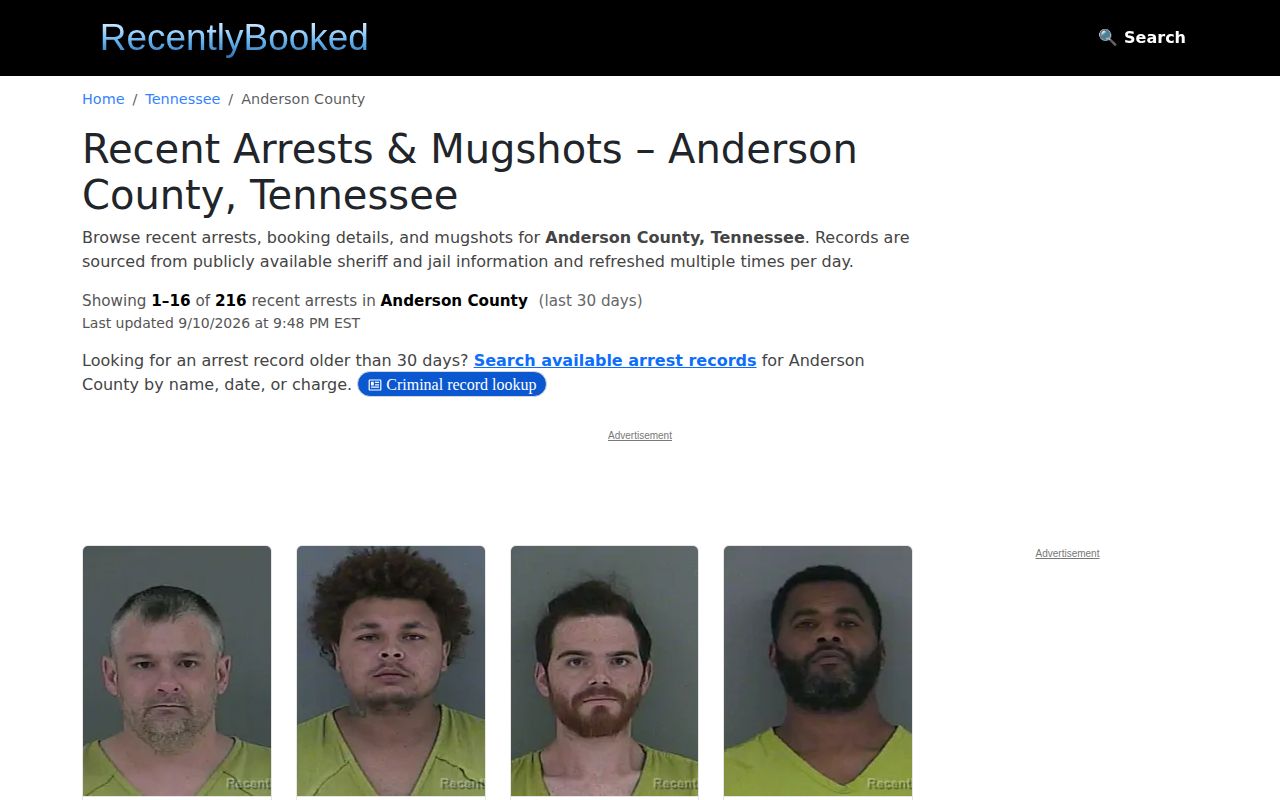
Its entries and update claims are not sheriff certification or proof of current custody.
Local News and Anderson Arrests
WYSH stands out because it points a locally titled current-inmates and last-24-hours page straight to ISOMS. The Courier News adds narrative. Its stories cover arrests in Clinton, Oak Ridge, Oliver Springs, and the county jail. A news account can name the agency, the event, and the detention destination after a jail card rolls away. Still, each story reflects reporting at one moment.
Check the publication date. Check the named source and the exact wording too. The words arrested, charged, indicted, and convicted are not interchangeable, so follow the Anderson County clerk docket to see whether counts were amended, dismissed, or resolved.
Request an Older Anderson Arrest
Older Anderson County entries roll off the log quickly. When one does, send ACSO Records a tight request. Spell out the full name. Add the date range, the agency, and the booking number if you have it. Say which record you want. An arrest report, a booking record, a release entry, and a photograph are each distinct record types, so naming the wrong one slows the whole thing down. The fees are modest. The official schedule charges $5 for an arrest report and $5 for a booking record. No photograph price appears. Ask for an estimate before paying.
If the custodian is unclear, the Anderson County public-records coordinator can route the request, and the county form requires proof of Tennessee residency. City narratives are different. For a Clinton, Oak Ridge, or Oliver Springs police narrative, go to that city department, while the jail record stays with ACSO whenever Anderson County handled intake. Splitting the request this way avoids asking a city to produce a county booking photo it may not hold.
Old records can raise retention questions. Ask ACSO for the series name and its retention authority, then ask Anderson County Archives whether that series transferred. The Archives publishes a public list of many permanent county holdings, though it does not promise recent jail photographs or arrest-log pages.
Anderson Arrest Log Versus Docket
The Anderson County arrest log captures intake. The docket picks up after that. Court procedure is its subject. Anderson publishes routes for General Sessions Division I in Clinton, Division II in Oak Ridge, and Circuit or Criminal Court. If a booking charge no longer matches the later case, contact that docket's clerk. A bond listed on the log can change at a hearing. A release date only records the departure from jail. It is not a dismissal.
Record an Anderson Log Check
Jot down the date and local time. Note the window label and the newest intake shown. Do this before leaving the portal. That small record lets the jail or records unit see exactly what was missing or inconsistent, and it separates real portal lag from a claim that no booking ever occurred. Never save or redistribute a booking photo just to document the search.